Sunday, March 21, 2010

RAVANGLA


RAVANGLA
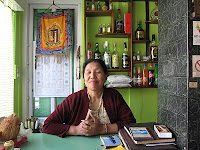
My next short stop is a larger village with several streets. I booked in to a Tibetan place where again no one spoke English but they all smiled and were very nice. The photo is of the nice owner.
Guessing what an item on the menu might be results in unusual combinations of food. Many things on the menu are not available at all and other meals are not listed. Again no light. Even big hotels did not have generators. It gets spooky wandering around in the dark. At night I ordered in a restaurant and after waiting two hours inquired about the dinner but the order had never gone to the kitchen. Another told me that they were full even though there was not one single person there. It’s my problem not having the language at all. There were few strangers around. Only met two English women who have been walking around these villages, they are not trekking as they are about my age. The picture is a poor attempt to show the winding roads around here.
While I was out trying to get dinner I realized that I had left my bag in the restaurant of my hotel on the chair. When I didn’t get served I left for somewhere else and didn’t notice that I did not have my handbag which contained money, my camera, glasses etc. I didn’t know if it had vanished in the new place or if I had left it in the first restaurant, went back immediately but it was closed already at 8.30 pm. I had to spend an anxious night getting up at 6 am and going in to the dining room as soon as it opened and there was the bag still on the same chair. No one had even noticed it probably as it was all intact. People here are most honest but anyone could have gone in for breakfast and walked out with it. Lucky again and very relieved.
I stayed in Hotel 10- Zing which is rather eccentric. I liked the Hotel Melody better and the owner speaks English but I sure needed a shower and he had only a bucket one. It has great views and cozier rooms than any of the others I checked. (hotel_melody@yahoo.co.in)

TASHIDING


TASHIDING
A different St Patrick’s Day. This village is a really small one on a ridge and is visited mostly only for a beautiful monastery filled with mantras carved by the best craftsmen, five monastic buildings as well as rooms for monks, novices and students of Bhuddism. It is also a starting point for trekking but there is a real dearth of restaurants, cafes and hotels. The only two I saw were so very dingy as Indian hotels can be. Linen is often not changed between guests and water is poured from a bucket instead of a tap. I don’t mind if it is a bit clean but here that didn’t seem to exist.
I heard that there is a guest house up in the monastery and a kind teacher agreed to drive me to the bottom of the steps there. Climbing all those steps is hard enough at the best of times but climbing it with the luggage of 5 months of travel clothes was really hard especially as the rain started with lightening, thunder etc I reached the top to find a very simple guest house with outside squat toilet and an outside bucket for washing. It was dark and the electricity was gone yet again As there is no restaurant up there I ate in the kitchen with the family and shared their meal. They cooked by candlelight. The meal was simple and good and I was delighted to be in out of the storm with a clean bed waiting. The man of the house made me a Thomba which is the millet beer served in a bamboo tall container to which is added boiling water at regular intervals. One is enough to last the night and it is quite potent so it is enough in every sense of the word. This one was especially good as it was homemade. Many other people came in and out of the kitchen they were all called cousin or sister and most seemed to spend the night. None of the others took a drink at all which seems usual here. In Nepal they mainly drink hot water. Everyone goes to bed around 8 pm. No chance of reading having no light.
The next morning the mountains were glorious after the storm with all the highest peaks visible. I had a serene walk around the monastery compound passing all of the monks at their various busy tasks - carving in stone, cleaning the butter lamps, praying, turning prayer wheels and teaching.
I was served a breakfast of a cup of masala tea and champa. I asked the woman of the house what it was and she said rice and “cow’s water”. It was almost solid, pale yellow in colour and they eat it by rolling it in to a ball and eating it with their hands. I love trying things but I don’t mind if I don’t have it too often.
Off I started again towards Darjeeling. Travel in these mountains is easy. One just has to be down at a point in every village around 6.30 a.m. and jeeps go in all directions. This time I was a bit late as the steps were not easy going down either. I took a taxi to the village and was told that there would be no further transportation going in the direction I wanted until the next morning so I waited a while and then thumbed down a car going in the right direction. I was lucky and he was a very nice person who worked for the government. It is not often that anyone speaks English in these villages except the government employees and teachers. The lack of understanding results in hilarious meals and bills for them. It is no use getting impatient or angry when food does not arrive. If they don’t understand they just forget about it.

YUKSOM, SIKKIM

YUKSOM

The mists did not clear and I did not ever manage to see those splendid views although I hear that they were visible the very next morningL C’est la vie.
Off we went in the hired jeep merrily and the family in the hotel draped the white silk scarf, the Khada, around my neck in friendship before leaving. We did not get very far before the jeep broke down so we sat by the road for an hour or two before deciding we would not have time for the sight seeing so two of our group walked back to Pelling and three of us continued straight to Yuksom in another jeep as the mechanic tried to work on the first one.
The picture is of a guru I met both in Pelling and Yuksom.
This is a really quiet small village, most of the trekking starts from here so the streets are full of small mules and yaks all loaded up with every imaginable object that one needs to go to these high altitudes. There are also many porters, cooks and guides and they have to bring every possible necessity. Most of the restaurants are tiny and one eats outdoors under straw covered roofs. The sun comes out every morning but by afternoon, this week, everything clouds over and strong wind and rain sets in. The storms have been bad and the electricity has gone out frequently so we are being romantic eating in the candlelight. Showers and hot water are scarce. Picture is of my little guesthouse where I was very happy.
Because there is not much to do here for the inhabitants they seem to laugh and play games a lot. Children and adults laughter is frequent. There are games of cricket, football, children chasing each other and general merriment . There is no bus service but jeeps run between the important points. Everything closes at 8 pm by law so it is very quiet. People get up very early as the jeeps leave at 6.30 and treks start out as early as 4 a.m.
The picture is of the girls from the guest house washing the clothes and scrubbing them on the stone. They are always singing as they work. The girl on the right was adopted by the family when she was young and her mother died.
I’ve been going on nice walks around and just enjoying the bloom of spring. Here among these mountains one meets the same people again and again as travelers wander between villages so sitting in the middle of the village until the jeeps arrive is a favourite past time as acquaintances from the last hotels pour out.
I left Yuksom on St Patrick’s Day feeling sorry to leave my tiny cozy room. I got up early and took a hike up a mountain to the top where there is a monastery – they are always at the top and have great views. It was a bit of a sweaty job as the mornings have turned warm with spring like weather. In the afternoons it often rains with very loud thunder in these mountains. It was beautiful and quiet up there and the walk down was great. I enjoyed breakfast in the sun before catching a jeep to go on to the next place. It seems that the leaving time has little to do with reality. I arrived on time and my luggage was piled on top and off we went but in the wrong direction. I don’t know why but after a while we returned to the original place where more people boarded. Then we waited for about an hour after which we started again but stopped literally every few minutes either for the driver to chat with someone, to shake hands, to hop off and buy something, to allow a passenger to hop off for some message etc., but finally we were off.
I stayed in Hotel Yangrigang, email yan@yahoo.com Cost around 300 to 400 Rs a room.
With the $ about 45 Rs and the Euro at 62.

PELLING, SIKKIM


PELLING

The next day we took a shared jeep again for a 5 hour ride to Pelling in West Sikkim. The districts here are named very simply North, South, East and West. Again the same bumpy roads but this time we had seats in the front with the driver. The jeep centre was a really chaotic place, no jeep seemed to have a set parking place and vehicles were parked facing every direction so the incoming jeeps could not enter, there were no set tracks, horns were blowing and cars facing in every direction. A driver would need the patience of Job to face that every time he arrived. We left an hour and a half late and then went to a hospital to pick up a young lad who broke both of his arms when he fell out of a high tree where he was collecting fodder for the cows. He was very uncomfortable as the jeep swung around curves but he never complained. His brother, who looked about a year older, fed him at lunch and held his glass of juice to his lips most attentively. His family are poor and not literate and they most likely sleep on the floor, so it won’t be easy for him to get a good sleep and be able to get up and dress himself or use the bathroom.
Pelling is at an altitude of well over 6000 ft. It is said to have the most fabulous views of the Himalayas especially of Kanchendzonga which is the 3rd highest mountain in the world at 8,588 ft. It was misty on arrival so hope that the weather clears. It is sunny most days but mornings and nights are again cold and most of the guesthouses are fairly open to the elements. We checked in to a most reasonable guesthouse at about $5 per room, a fun backpacking place full of a variety of people from many nationalities. It felt good to be out sitting on a terrace swopping travel yarns and information. For Mindup it was his first experience staying in a place like this since usually he is in more up market hotels with his clients and he really enjoyed networking and getting to know younger travelers. The high cost of travel in Bhutan means that mainly well off people go on tours there and so the guides and drivers never meet young, easy going people. Here we quickly joined in with a group of nice people and we put the tables together at night and ate together. Here is Mindup

explaining some Buddhist principles to nice French guests Patrick and Christine.

The food here is varied and inexpensive and the owners and staff are great. Indian guests are very demanding and don’t hesitate to ring the bell in their room for small things like a spoon even at 2 am so the staff really have to scurry about and they are glad to serve meals on the terraces or the roof.
There is not much to do here except enjoy nature, walk, visit monasteries and read. There were some wonderful ceremonies at a nearby famous old monastery and we all went. The monks sit for hours performing wonderful chanting, horn blowing and music. The walls are painted with old, elaborate murals. One of the important monks here, named Yapu, started a school in the 1980s for over 100 children who are orphaned or poor. That is his picture on the left.
It is a very happy place and the children speak very good English. They are so polite and each older child befriends a younger one and they wander around hand in hand or arm in arm. I ate lunch there twice with a wonderful 85 year old man Gupta who was the first principle of the school. He is busy writing a book on Sikkim Past and Present. We had walks together, he can still manage the very steep steps to the monastery where he has a room. The photo on the left is of both of us, he wanted a copy of it and is delighted with it. He's a great man.
Some of the funds for the food for the school come from a little bakery that the monk set up and there are two, young French people there volunteering for a month to teach the older children how to bake pizza, pies and buns. They told me that the day’s earnings immediately go to buy veg and rice for the meals. The teachers are great too as they only receive 3,500 rupees a month ($80) while teachers in the government schools get 18000 to 24000. This is the girl's dorm and it is spotless.
Mindup returned to Bhutan and his work there and tomorrow I will take a jeep to another of the little towns here stopping to visit a lake and a few waterfalls along the way. The mist here has never cleared up so haven’t been able to take pictures from this heightL just maybe in the morning before leaving at 9 am.
I was very happy here staying at the Hotel Garuda, an easy going place with devout Buddhist owners. The restaurant there is plain but very good and they will deliver food to the rooms or terraces so one can breakfast in the sun. These are the lovely owners of Garuda, they had just given me the silk scarf as a good bye gift.


Their email- garuda_pelling@rediffmail.com Room rates are from 100 Rs for a dorm bed to 350 Rs for a room.

Saturday, March 13, 2010

SIKKIM IN THE HIMALAYAS

SIKKIM in the Himalayas
The landscape of Sikkim is very like that of Bhutan. Towering mountains, splendid views, hair pin bends and valleys so far below the roads that one cannot see the bottom. It is situated between Nepal on the west, Bhutan in the east, Tibet in the north and Weest Bengal in the south. It is a small stretch of land only 115 kms by 65 kms.and it has a population of 540.000. One needs an extra permit to enter the area. It is a nice place to be, very different than the rest of India. Crime is negligible, it is not dogged by social problems and economic problems. There is no discrimination against women as in many other Indian states. They were the first state to ban plastic bags and the use of fertilizers and pesticides. It is a hotspot of biodiversity for example it has only 0.2 percent of the area of India but has 26 percent of its bio diversity. The people are a mix of Tibetan refugees, Nepalis, Lepchas, Buthutias and Bengalis. Everyone seems to know everyone and they don’t have any house numbers so your directions to a house could be “the house near the tree etc” Because it lies at a low latitude and is near the Tropic of Cancer, the snow line is about 20,000 ft. There are houses up as high as 17,000 ft. while in the Alps on Mt. Blanc there is always snow at an altitude of 15,000 ft.
Here, as in Bhutan and Nepal, the people are so nice to strangers and to each other. All ages and sexes walk along holding hands and linking arms and they give a big broad smile when greeted. Almost everyone shakes hands often using two hands to grasp each other which is a mark of respect. Most ask “where you from” and nod wisely at the answer even though they are not a bit sure where that land is. Literacy here is very high and poverty is not evident. They seem like Buddhist people at ease and satisfied with their lives.
Mindup and I crossed here by shared jeep from Bhutan – a bumpy ride. There are no buses on these very high roads, only jeeps can manage to reach the top.
First we went to Gantok, the capital, but just stayed for two nights as a city is a city and not all that interesting. Lots of traffic, horns blowing and noise except in the main street which is a pedestrian area. I took a chance and went in to a tiny hairdresser shop with 2 chairs and a very tiny man cut my hair. He could hardly reach my hair on top when I sat in the chair and he did not speak English but he did a great job and also gave me a free head massage. The total cost was 50 rupees or less than a euro so of course he received the big sum of 100 rupees. There are few foreigners in Sikkim although I am told that many Indians and Bengali’s visit during the high season. Now it is off season so the streets are full of women in beautiful saris, Tibetan national dress, a few in Bhutanese Kiras, all very graceful in their long skirts and wrapped with shawls or blankets during the early mornings and late evenings. We ate at several really good restaurants there are more vegetarian places than usual restaurants in fact most are vegetarian. For the first time in weeks there was also an opportunity to have a cup of real coffee instead of Nescafe powder

FAREWELL TO BHUTAN


FAREWELL TO BHUTAN
I am now retracing the same road back from east to west to reach the exit point from Bhutan. There is another one to Assam but that would be a round about way to reach my next destination of Sikkim in the north of India. Long days along the same roads of constant curves but this time did have lunch at a real local restaurant for once and it was really nice to be among the people here instead of some approved hotel alone or with tourists. The owner is a most congenial head of the family too who spoke English and grows medicinal herbs that he sells. Since it was warmer outside than inside the washing machine had been moved out and the days washing was done outdoors. The machine washes but it looks as if the rinsing must be done by hand so the sun was nice to warm the back. One of the main foods here is chili with everything so here it was really fiery.
I’ll put in a picture of the rather primitive loo there. I noticed that the locals just seemed to order a big plate of rice and a little bowl of chili to spice it up.
We spent a night in Thronsa where the girl who served was falling over herself to be really kind. She fixed us butter tea without us asking (I don’t really like it) and two different kinds of porridge for breakfast so that we could try Tibethan maize or wheat porridge. She told us that the owner and family took her in when she was very young and now they were her family although she had a family up in the mountains. I heard this kind of story very often. It seems that people who have some success often just take in children who live too isolated to have many opportunities in life and their parents are happy to let them go.
Back in the capital of Thimpu we went for a real coffee at real western prices but it was so good after all the Nescafe of the last two weeks. That night we went to a bar with several of Mindup’s nephews. The extended family here is really wide and they call each other brother/sister/cousin etc even when they are not really that close. The lads were about 18 and had just finished their school studies but few of the people here really take a drink so they celebrated with juice. There was Bhutanese Karaoke on and it was not loud at all and none of the people seemed self conscious about joining in.
Next day we drove on towards the border town of Puentsholing where there is actually only an arched gate between Bhutan and India but one has to go through formalities like stamping departure at one office and then going to Indian emigration with the visa at another – time consuming especially as it had to be done at 7 am. This is, of course, only for foreigners the two countries can go in and out as they wish but Bhutanese money, the Nu, is not accepted anywhere except Bhutan. We booked a shared jeep for the trip to Sikkim and left the car at Mindup’s sister’s house. His brother in law drove us around all the offices and to the jeep the next morning.
The difference between Bhutan and India was evident immediately. From 50 yards to the other side there was again heaps of trash, the concrete, dirt, bricks and general debris that is not present in Bhutan. The jeep was packed 4 in each row so we were well sandwiched for the curves ahead. Unlike India there are regulations in Bhutan that prevent overcrowding of vehicles whether private or public so there is none of the people on the roof and hanging on that one sees in India, Burma, Laos etc. It seems to me that the government in Bhutan lays down many rules that are not questioned by the people. It is sad to know that one will not be returning to this place of really lovely, pleasant, kind people with so much patience and inner strength and peace.

Thursday, March 4, 2010

IN THE EAST OF BHUTAN

TASHIGANG AND THE EAST


This is an elderly very sweet nun who asked me to take her picture. She held on to my arm and we had to do several circumambulations of the monastery together. The monk said that she is about 60 years old but no one here knows their birthdays.
The others are cleaning the butter lamps


Bhutanese boy friends.


3 March ‘10
We’re on the way back to the border in the west with long drives along those high roads and hair pin bends. Snow has fallen since we last passed this way but already there are many more open Rhododendrons and Daphne in bloom, paper is made from the latter. I will leave Bhutan on the 6th for Sikkim.

The east was the most interesting part of the country for me. The people there rarely see a stranger and a group gather around quickly at each stop. The school children love to try their English and are full of smiles. Older people offer tea or coffee and everyone is very shy. There are many very poor people working on the roads. Women with children on their backs and other children beside them are sweeping miles of road with a broom or actually working in construction. Men building a house in one town are hauling concrete and sand in a sling tied to a long pole up to a second story repeatedly. See a picture of the labour intensive building methods. We passed high passes covered with prayer flags. It seems that the white flags are to honour the dead and the coloured ones are referring to contentment and happiness in the present life. Talking about the dead – Mindup and his family wanted to honour their father when he died 2 years ago and show him respect for his hard work and endeavors in educating them so the eight of them paid $900 for a ceremony that lasted 21 days. He said that the entire village does all the cooking and work for such an occasion, an important lama or Rinpoche comes and about 40 monks to lead the prayers and chanting. The Buddist teaching is most obvious in every day life here. People take responsibility for elderly relatives who move in to their home even if they are not really close kin. Young girls are adopted in to families and educated by them if they have little money in their own family. Bhutanese walk in and out of kitchens in private homes even if they don’t know the family and food is always available for drop ins even if it is very plain like just rice. Trucks are gaily painted with “Welcome. We Love our King. Take care,blow horn. No girlfriend no tension” and other messages that usually show kind thoughts or advice. Driving along we passed by a woman up on a very high road with no houses in sight and she was prostrating herself every step and was probably going to do so for miles. We later passed by a monk doing the same thing probably for merit or in reparation.
We stayed in Tashigang and visited some little villages around where women were weaving on very primitive looms outside their houses. This area is renowned for silk weaving. Their patterns are most work intensive. A panel for the Kira, the women’s dress takes 4 months to weave and costs up to $1000 so most women weave he houses to fix lunch for us so that I could try a real farmhouse meal. She was glad to do it and also gave us some local moonshine called Ara which is traditionally served with a scrambled egg in it which seemed very odd but “when in Rome do as the Romans do” etc so of course I had a go. Not bad at all.
There was an Archery game going on using home made bows with the men doing ththeir own clothes. Mindup asked a woman in one of teir little dance each time an arrow hit the target across a huge distance. It was a holiday as it was the last day of lunar New Year.
Houses here have painted designs on them including huge penises. This is said to promote well being, happiness and fertility.
One disturbing thing among the common practices is the chewing of the betal nut by so many which, of course, stains their mouth and teeth red. It is used a lot in Asia mostly by the hill tribes and elderly but here it is also used by young people. Ganga grows wild here but is forbidden by law and Buddism.

MONGAR
We were in Mongar yesterday for a visit to a ceremony that is going on there for a week. It was because of the earthquake in the east of the country and it took a long time to get the money together to have such a ceremony where a Reincarnation or Rinpoche is asked to come and preside over the event and it is attended by at least 1000 monks and thousands of people who all have to be fed for the duration. Everyone chants and prays and asks the Rimpoche for a blessing. It was organized by Mindups village and he personally gave $1000 towards the cost. The village is up too high to reach with cars so the event was held in the nearest town. The people setting it up were so weather worn, gentle and hard working. We were seated on two very nice chairs and offered tea and biscuits. The only ones seated. Everyone gathered around and those who could speak English tried to have a conversation. Yesterday we had a private blessing by the Rimpoche and he draped the traditional white scarf around my neck. I probably need it as a monk read my horoscope last week and it was only so-so. Mindups was not good so he has been trying to improve it by gaining lots of merit and doing good works. It looks as if all will be well for him however as he rolled dice in the monastery and turned up an eleven – a really good omen. We roll along in the car to his chanting at times, at other times he sings away and he just loves the tunes on my I pod and tries to lilt Irish music.